


7 Roofing Scams to Watch For in Northeast Ohio (And How to Avoid Every One)
Date Posted:
April 23, 2026
Author:
Daryl Gentry

In 2024 alone, the Ohio Attorney General's Consumer Protection Section obtained more than $50 million in judgments and settlements — and home improvement fraud consistently ranks among the top complaint categories the office receives each year.
Most roofing schemes follow a predictable pattern: they spike after storms, rely on urgency, and target homeowners who want the problem solved fast.
Once you know what to look for, these tactics are easy to spot. This guide breaks down the seven most common roofing scams in Northeast Ohio, the red flags that signal danger, and the steps that keep you protected.
Key Takeaways
- Storm chasers are the most common threat — out-of-state contractors who disappear after collecting a deposit
- Offering to waive your deductible is illegal — it's insurance fraud, and you can be held liable
- Never pay more than 10–20% upfront before materials are delivered
- Ohio gives you a 3-business-day right to cancel any contract signed at your home
- Verify both general liability and workers' comp insurance — not just one
- A legitimate contractor welcomes comparison — they never pressure you to sign same-day
- Always get a written, itemized contract before work begins
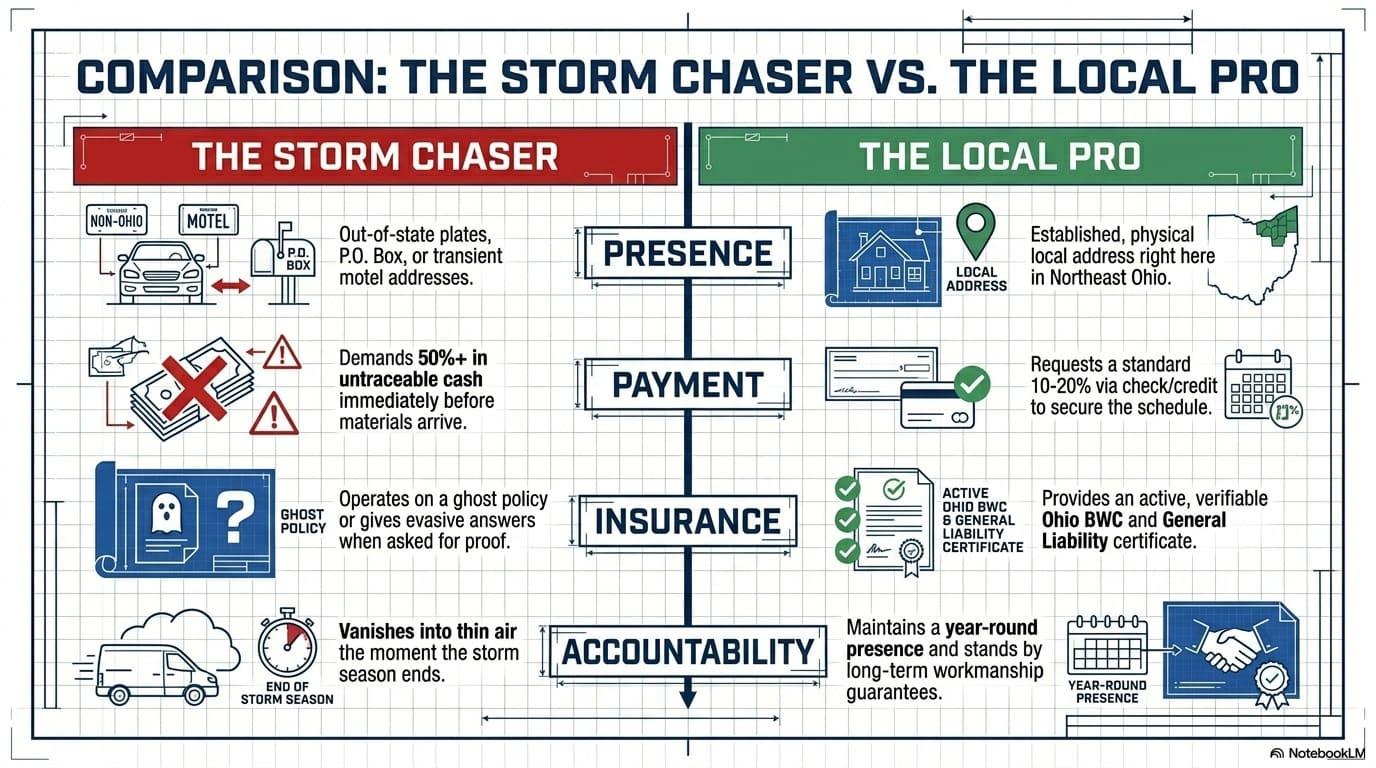
1. The Storm Chaser Scam
Storm chasers are out-of-state contractors who flood Northeast Ohio neighborhoods after wind events, hail storms, and derechos, offering quick repairs before disappearing with your money or delivering substandard work.
They knock on doors claiming they were "just working on your neighbor's roof." They create urgency: the damage is severe, slots are filling up, sign today. The problem isn't that they're strangers. It's that they have no local address, no accountability, and no reason to stand behind your roof two months after they leave town.
Northeast Ohio's spring storms and summer derechos regularly trigger waves of out-of-state solicitation. After a major wind event, unfamiliar contractor vans appear in Akron, Canton, and Massillon neighborhoods within 48 hours.
Red flags:
- No local physical address (P.O. boxes don't count)
- Out-of-state license plates or phone numbers
- No verifiable online presence or reviews
- Pressure to sign before getting other quotes
What to do: Never sign with a contractor who approached you unsolicited after a storm. Call your insurance company first, then reach out to a local, established roofer to schedule an independent inspection.
2. The Large Upfront Deposit Disappearing Act
Demanding a deposit of 50% or more before materials are ordered or delivered is one of the most reliable warning signs of a roofing scam.
A legitimate roofing contractor typically asks for 10–20% upfront to reserve your place in the schedule. That's standard. What's not standard is asking for half the job cost in cash before a single shingle arrives. Once that money is gone, you've lost most of your leverage. Some contractors deliver nothing. Others show up, do a few hours of work, then walk off the job and become unreachable.
In March 2026, Ohio Attorney General Dave Yost sued Virginia-based CMN Group after the company descended on Northeast Ohio following the August 2024 storms, collected more than $188,000 in deposits from 24 homeowners for roofing and siding work, and ghosted them without completing the contracted repairs.
The lawsuit was filed in Cuyahoga County — right next door to the communities TK Roofing and Gutters serves.
Red flags:
- Deposit request of 50% or more before work begins
- Insistence on cash or untraceable payment methods
- No materials arriving before work is supposed to start
- Pressure to pay quickly to "hold your spot"
What to do: Never pay more than 10–20% upfront. Tie remaining payments to project milestones — materials on-site, tear-off complete, installation complete. Always pay by check or credit card, never cash.
3. The Deductible Waiver: It's Not a Deal — It's a Crime
When a contractor offers to "waive your deductible" or cover it out of their pocket, they are describing insurance fraud — and under Ohio law, the homeowner can be held criminally liable, not just the contractor.
Here's how it works. The contractor submits an inflated invoice to your insurance company that includes the deductible amount. They bill for premium materials, install cheaper ones, and pocket the difference. Your deductible was never waived — it was baked into a fraudulent claim. You get less roof for the same money, and your insurance company may cancel your policy.
Under Ohio Revised Code § 2913.47, knowingly participating in a false insurance claim carries felony exposure — for both the contractor and the homeowner. "I didn't know" is a harder argument after you signed the paperwork.
Red flags:
- "We'll cover your deductible" — any version of this phrase
- Offers to handle your insurance claim entirely without your involvement
- Vague contract language with no itemized materials list
- Invoice amounts that suspiciously match your insurance payout exactly
What to do: Pay your deductible. It's a legal requirement and a financial responsibility. Any contractor who tells you otherwise is putting you both at legal risk.

4. The Assignment of Benefits Trap
Signing an Assignment of Benefits (AOB) transfers your insurance claim rights to the contractor — meaning they can negotiate directly with your insurer, inflate the scope of work, and collect payment without your approval.
An AOB is not always fraudulent. In some legitimate scenarios, contractors use them to streamline the claim process. But signing one before you've gotten competing bids, or under pressure from a door-to-door solicitor, removes your visibility into what's being claimed and approved on your behalf.
The National Association of Insurance Commissioners (NAIC) advises that homeowners are never required to sign an AOB to have repairs completed. You can file your claim directly and maintain control of the process.
Red flags:
- AOB requested before you've agreed to hire the contractor
- Pressure to sign before your insurance adjuster visits
- Contractor insists they "handle everything" with your insurer
- No explanation of what the AOB covers or limits
What to do: Never sign an AOB under pressure. If a contractor requests one, review the document with your insurance agent first. You have the right to manage your own claim.
5. The Free Inspection That Creates Damage
Some dishonest contractors use unsolicited "free inspections" as an opportunity to fabricate or exaggerate damage, justifying costly repairs or full replacements that your roof doesn't actually need.
This is one of the harder scams to catch because it happens out of your sight. The BBB Scam Tracker includes accounts of contractors who descended from a free inspection holding a damaged shingle that didn't match the homeowner's roof — one they'd brought with them. Others crease shingles or loosen flashing to manufacture "proof" of failure.
Not every free inspection offer is a scam. Many legitimate roofers offer them as a standard service. The difference is who's asking and when. An unsolicited knock after a storm from an unknown contractor is very different from scheduling with a local company you've researched.
Red flags:
- Unsolicited free inspection offer, especially from a door-to-door solicitor
- Damage "discovered" during inspection that seems inconsistent with the storm event
- Contractor can't produce photo or video documentation from your specific roof
- Immediate pressure to approve a full replacement based on the inspection findings
What to do: Take photos of your roof before any contractor goes up. If damage is reported, request photo documentation and get a second opinion from a separate licensed local contractor.
6. Low-Ball Bids and the Price-Hike Trap
A bid that comes in significantly lower than two or three other estimates isn't a deal — it's a setup for substandard materials, unpermitted work, or a mid-project demand for more money once you're already committed.
Roofing costs are built on fixed inputs: material quality, skilled labor, disposal, permits, and proper flashing and ventilation. A contractor bidding 30–40% below market is skipping materials, skipping permits, using unlicensed labor, or planning a price increase mid-job — after the tear-off, when you have no roof and limited leverage. This bait-and-switch pattern shows up repeatedly in complaints filed with the Ohio AG's office.
Red flags:
- Bid 30% or more below the other estimates you've received
- Estimate is verbal or vague, with no itemized materials list
- Contractor cannot explain why their price is lower
- New "damage discovered" after tear-off that significantly changes the price
What to do: Get three written, itemized estimates. Ask each contractor to specify the shingle manufacturer, product line, underlayment brand, and ventilation approach. If a low bidder can't answer those questions, that's your answer.
7. Permit Evasion and Unlicensed Work
A contractor who asks you to pull your own building permits — or who skips permits entirely — is either unlicensed, trying to avoid accountability, or both.
Ohio does not issue a statewide roofing license, meaning anyone can advertise roofing services without passing a state exam. What does exist: municipal registration requirements and bonding mandates at the city or county level.
Legitimate roofing companies operating in Summit, Stark, Portage, and Medina counties are registered with their municipalities and carry general liability and workers' compensation insurance through the Ohio Bureau of Workers' Compensation (BWC).
Unpermitted work creates real downstream risk — complicating insurance claims, creating liability during a home sale, and bypassing the municipal inspection that confirms the work was done correctly.
Red flags:
- Contractor asks you to pull the permits yourself
- No mention of permits in the contract or scope of work
- Cannot produce a Certificate of Insurance when asked
- Workers' comp certificate only covers the business owner, not the crew
What to do: Ask for a Certificate of Insurance before signing anything. Call the insurer directly to confirm active coverage — don't just accept the document at face value. For detailed guidance on verifying contractor credentials in Ohio, see our guide on how to verify a licensed and insured roofing contractor.
How to Hire a Roofing Contractor You Can Trust
Protecting yourself from roofing scams comes down to four actions: verify credentials, get competing written estimates, understand your insurance rights, and never let urgency replace your due diligence.
Before You Sign Anything
- Request a Certificate of Insurance — verify both general liability and workers' compensation coverage by calling the insurer directly
- Check BBB and Google reviews — look for consistent, detailed reviews from real homeowners, not a cluster of identical five-star posts
- Get three written, itemized estimates — compare materials, labor, warranty terms, and payment schedules side by side
- Never pay a large downpayment — contractors may try high-pressure tactics to get you to put down a large deposit. Do Not Do It
Know Your Ohio Rights
Under the Ohio Home Solicitation Sales Act (Ohio Revised Code § 1345.21–.28), any contract signed at your home gives you a 3-business-day right to cancel. No legitimate contractor will deny you that right. If a contractor insists the offer expires immediately or asks you to waive your cancellation rights, walk away.
If you believe you've been defrauded, report the contractor to the Ohio Attorney General's office and file a complaint with the Better Business Bureau.
Frequently Asked Questions
How do you tell if a roofer is scamming you?
A roofer is likely scamming you if they demand large upfront cash payments, pressure you to sign same-day, offer to waive your insurance deductible, or cannot produce a verifiable Certificate of Insurance. Legitimate contractors provide written contracts with itemized materials, carry active insurance you can verify independently, and welcome you to get competing estimates. If the deal feels rushed or the offer sounds too good to be true, take time to research the company before committing.
Is it illegal for a roofer to waive your deductible in Ohio?
Yes — offering to waive a homeowner's insurance deductible is illegal in Ohio and constitutes insurance fraud under Ohio Revised Code § 2913.47. Both the contractor and the homeowner can face felony charges for participating in this scheme, even if the homeowner didn't initiate it. Any contractor who offers to "cover" or "absorb" your deductible is describing a fraudulent arrangement you should decline and report to your insurance company.
What should I do if I already paid a contractor who disappeared?
If a roofing contractor took your deposit and disappeared or failed to deliver work, file a complaint immediately with the Ohio Attorney General's Consumer Protection Section and report the company to the BBB Scam Tracker. Contact your bank or credit card issuer to dispute the charge if you paid by card. Document all communications, receipts, and contracts. Ohio's Consumer Sales Practices Act provides legal remedies for homeowners defrauded by contractors, and the AG's office actively prosecutes these cases.
What is a "ghost policy" and why does it matter for roofing?
A ghost policy is a workers' compensation certificate that covers only the business owner — not the crew members on your roof — creating hidden liability for homeowners if a worker is injured on their property. Because Ohio is a monopolistic workers' comp state, all employers must cover their workers through the Ohio Bureau of Workers' Compensation (BWC). Ask your contractor whether their policy covers all employees, not just the principal, and verify active status through the Ohio BWC website.
The TK Roofing and Gutters Difference
TK Roofing and Gutters is a family-owned roofing contractor based in Akron, Ohio, serving Summit, Stark, Portage, and Medina counties since 2003 — same core crew, same local address, same accountability every year.
Owner Daryl Gentry backs every project with a 20-year workmanship warranty. That's double the industry standard of 10 years. TK Roofing and Gutters holds GAF Certified Plus, CertainTeed Select ShingleMaster, and Owens Corning certifications carries an A+ BBB rating, and is fully licensed, bonded, and insured. We're not chasing storms. We're here year-round.
If you've received a suspicious estimate or want a no-pressure second opinion, call (330) 858-2616 to request a free inspection. We serve Akron, Canton, Massillon, Stow, Hudson, Cuyahoga Falls, Green, and surrounding Northeast Ohio communities.

Call Us
(330) 858-2616
Email Us
info@tkroofingandgutters.com
Visit Our Office
3256 South Main St. Akron, Ohio 44319

Hours
9am - 5pm
Monday to Friday
Closed Holidays
Monday to Friday
Closed Holidays
Related Posts
 How Do I Tell If a Roofer Is Pushing Replacement When Repair Is Enough?
Learn the four tests that separate a legitimate replacement recommendation from scope inflation, and why who pays your roofer matters as much as what they find.
Read Article
 My Roof Is 15 Years Old and I Have One Leak: Repair or Replace?
A single leak at 15 years usually traces to failed flashing, not a dying roof. Here is how Akron homeowners can tell repair from replacement with confidence.
Read Article
Search


